
Hiring managers have seen a thousand chatbot demos. What they rarely see is a candidate who shows the *production* side: evaluation, reliability, cost and safety. These five projects are designed to show exactly that.
What makes a portfolio project stand out
- A real problem, even a small one, instead of a generic chatbot.
- Evals that prove it works, with numbers.
- Operational details: logging, latency, cost per request, what happens on failure.
- A clear write-up explaining trade-offs you made and what you’d change.
1. RAG over public documentation, with evals
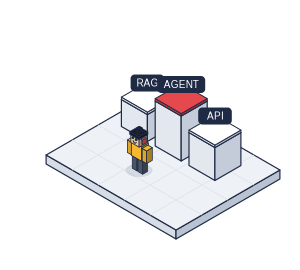
Pick a public corpus you understand: a city’s open-data documentation, a framework’s docs, your own notes. Build retrieval with citations, then publish an eval set and your retrieval hit rate. Guide: RAG with Postgres and pgvector.
Shows: retrieval, chunking, evaluation, honest measurement.
2. A production-style LLM API
Wrap a model behind an API with authentication, token-based rate limits, streaming, timeouts, a fallback model and a dashboard of latency and cost.
Shows: the reliability skills most AI candidates skip.
3. An agent with guardrails
Build an agent that does something useful with tools (triaging GitHub issues, summarising logs) but with read-only defaults, an approval step for any action, and a full audit log.
Shows: you understand that agents need permissions, not just prompts.
4. Self-hosted model benchmark
Run two or three open-weight models on your own hardware or a cloud GPU. Measure tokens per second, memory use and quality on your own eval set. Publish the results and your setup.
Shows: you understand inference, quantisation and hardware trade-offs. My notes on home lab networking cover exposing it safely.
5. A data-residency-aware design
For Canadian employers (banks, insurers, healthcare and government suppliers) where data lives matters. Design a small app that keeps personal data in a Canadian region and documents what leaves it and why. Background: Canadian data residency for AI apps.
Shows: you can work in regulated environments, a big part of the Toronto market.
How to present it
- One README per project: problem, architecture diagram, eval results, cost per request, known limitations.
- A short blog post per project. Writing is proof you can explain trade-offs to a team.
- Pin the two strongest projects; quality beats quantity.
FAQ
Do I need a GPU for AI portfolio projects?
No. Most projects work with hosted APIs. A GPU helps for self-hosting experiments, and cloud GPUs can be rented by the hour.
Should I fine-tune a model for my portfolio?
Only if it solves a real problem better than prompting or retrieval. Showing that you measured the difference is more impressive than the fine-tune itself.
How many projects do I need?
Two or three strong, well-documented projects beat ten demos.