
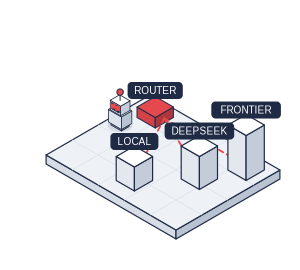
Most “which coding agent?” articles end with “pick one”. In practice the best setups in late 2026 route different tasks to different models. The harness stays the same; the model behind each task changes. Here is a routing strategy you can actually run.
Why route at all
Three things vary wildly between models: quality on hard problems, price, and where your code goes. A refactor across forty files deserves the best model you can get. Renaming a variable, writing a docstring or summarising a diff does not. And some code should never leave your network.
The three lanes
- Frontier lane: hard reasoning. Large refactors, debugging production issues, architecture changes. Use a frontier model such as Claude Opus in Claude Code, where the harness and the model are tuned together.
- Volume lane: cheap and good enough. Tests, docs, boilerplate, summaries, bulk edits. Open-weight models have become strong here. DeepSeek V4 (released April 2026 under the MIT licence) comes in a large Pro variant and a much smaller Flash variant (about 284B total parameters with roughly 13B active), and its hosted Flash pricing has been a small fraction of frontier pricing.
- Private lane: never leaves the building. Regulated code, secrets-adjacent work, offline work. A local model through Ollama or vLLM on your own GPU. Quality is lower, but the data boundary is absolute.
Prices and benchmark numbers change monthly. Re-check your provider’s current pricing and run your own evals before you commit to a lane.
How to route in practice
- OpenCode is model-agnostic (dozens of providers plus local models), so you can switch models per session or per agent configuration.
- Claude Code runs Anthropic models, so it is your frontier lane by design.
- DeepSeek’s harness, released as a developer preview in August 2026 under MIT, treats everything as a plugin and can drive other agents such as Claude Code as sub-agents. That makes it an interesting router, though as a preview it is still changing quickly.
A simple rule set to start with:
task touches > 10 files or is a production bug   -> frontier lane
task is tests / docs / formatting / summaries       -> volume lane
repo is tagged confidential or you are offline      -> private lane
Measure before you trust a cheaper lane
Pick 20 real tasks from your own history, run them through each lane, and score the results (tests pass, review comments, time taken). The method is the same as LLM evals for engineers: real examples, repeatable checks, no vibes.
Keep the instructions model-neutral
Routing only works if every model gets the same rules. Keep instructions in a shared AGENTS.md (with CLAUDE.md pointing to it), as described in Syncing Opencode and Claude Code skills, and keep repo checks in one command every model can run.
Self-hosting the volume lane
Large open-weight models need serious hardware: the biggest variants are multi-GPU, data-centre class. For a home lab, a smaller open model on a single GPU is realistic, and it doubles as your private lane. If you are planning the network side, see home lab networking with WireGuard.
FAQ
Is DeepSeek V4 good enough for coding agents?
For many routine tasks, yes, and at a fraction of frontier cost. Test it on your own tasks; results vary by language, codebase and harness.
Can I use DeepSeek models in Claude Code?
Claude Code is built around Anthropic models. Use a model-agnostic harness such as OpenCode for DeepSeek and other providers.
Is a local model worth it for coding?
For private or offline work, yes. For hard multi-file changes, frontier hosted models are still clearly ahead.