
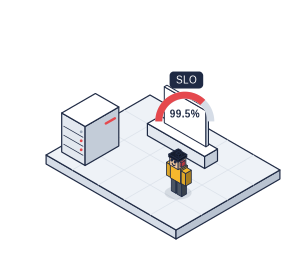
Classic SLOs ask two questions: did the request succeed, and was it fast? LLM features add a third: was the answer any good? Here’s how to define reliability for AI features in a way an on-call engineer can actually use.
Start from the user journey
Pick the moment users care about: “I asked a question and got a useful answer quickly.” Then break it into measurable parts.
Three SLIs for LLM features
- Availability: the share of requests that return a response without an error or timeout. Count fallbacks to a backup model as successes if the feature still worked.
- Latency: time-to-first-token for streaming features (it’s what users feel), and total time for non-streaming ones.
- Quality, the share of responses that pass automated checks: valid structure, no guardrail violations, and a passing score on sampled model-graded evals.
Example SLOs
- Availability: 99.5% of requests succeed over 28 days.
- Latency: 95% of requests reach the first token within 1.5 seconds.
- Quality: 98% of sampled responses pass structural checks; eval pass rate stays above the last release baseline.
Your numbers will differ. The point is to write them down and agree on them.
A provider outage, a GPU node failure and a prompt change that breaks JSON output are all incidents. Only the first two show up in classic uptime dashboards.
Error budgets that include wrong answers
An error budget is the amount of failure you can afford. For LLM features, spend it on:
- Errors and timeouts.
- Responses that fail validation.
- Quality regressions detected by evals.
When the budget is burning fast, slow down risky changes (model swaps, prompt rewrites) just as you’d pause risky deploys.
Alert on burn rate, not single failures
Model APIs fail occasionally. Alerting on every error trains people to ignore pages. Alert when the error budget is being consumed much faster than planned over both a short and a long window. That catches real incidents and ignores blips.
Instrumentation you need
Every SLI above depends on good telemetry: per-call latency, outcomes, validation results and eval scores. Retrieval quality feeds straight into this (see RAG with Postgres and pgvector), and measuring quality starts with LLM evals for engineers.
FAQ
What’s a good latency SLO for a chatbot?
Time-to-first-token is the metric to set. Many teams aim for one to two seconds at the 95th percentile, depending on model and region.
Can quality really be an SLO?
Yes, if you measure it consistently: structural checks on every response plus model-graded evals on a sample.
Should fallback responses count as failures?
If the user still got a useful answer, count it as success, but track fallback rate separately.