
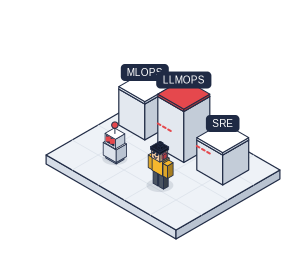
Job titles in AI change every six months. The work underneath them changes much more slowly. Here’s a plain comparison of MLOps, LLMOps and SRE, and why “AI infrastructure engineer” is really the overlap of all three.
MLOps: shipping models you train
MLOps grew up around teams that train their own models. It owns:
- Data and feature pipelines.
- Training and retraining jobs, experiment tracking.
- Model registry, versioning and deployment.
- Monitoring for data drift and model quality.
LLMOps: running products built on large language models
LLMOps is MLOps for a world where you mostly use models rather than train them. The focus shifts to:
- Prompt and configuration versioning.
- Evaluation sets and regression testing for LLM behaviour.
- Retrieval pipelines (embeddings, indexes, freshness).
- Token cost, latency and provider management.
- Guardrails: safety filters, PII handling, output validation.
SRE: keeping any service reliable
Site reliability engineering doesn’t care whether the service is AI. It owns:
- SLOs, error budgets and alerting.
- Capacity planning and load testing.
- Incident response and post-incident reviews.
- Automation that removes repetitive operational work.
Side by side
- Unit of change, MLOps: a trained model. LLMOps: a prompt, model choice or retrieval config. SRE: a deployment or config change.
- Main failure mode, MLOps: silent quality drift. LLMOps: wrong, unsafe or expensive answers. SRE: outages and slowness.
- Key metric, MLOps: model accuracy on fresh data. LLMOps: eval pass rate and cost per request. SRE: SLO attainment.
AI infrastructure engineering is the overlap
An AI infrastructure engineer runs the platform that all of the above sits on: GPU clusters, inference servers, gateways for model providers, tracing and cost dashboards. It needs MLOps’ respect for data, LLMOps’ grasp of model behaviour, and SRE’s obsession with reliability. That’s why people from SRE and DevOps often move into it successfully, and why it’s one of the more interesting paths for an AI engineer in Toronto, where banks and SaaS companies care a lot about reliability and audit.
Moving from SRE or DevOps into AI infrastructure
- Serve a model yourself and load-test it: a home lab is fine (see self-hosting an LLM with Ollama).
- Learn evals. It’s the one genuinely new discipline; everything else maps to things you already do.
- Instrument LLM calls like any other dependency: latency, errors, saturation, plus tokens and cost.
- Bring incident discipline to AI features. Your experience with runbooks makes you valuable here, and agents can help (see AI agents for incident response).
FAQ
Is LLMOps just a buzzword?
The name is new; the problems are real. Versioning prompts, evaluating outputs and controlling token spend are jobs someone has to own.
Do I need to know how to train models for LLMOps?
Not usually. Understanding fine-tuning helps, but most LLMOps work is around evaluation, retrieval, serving and cost.
Which role pays more?
It varies by company more than by title. Roles that combine production reliability with AI depth tend to be the hardest to hire for.