
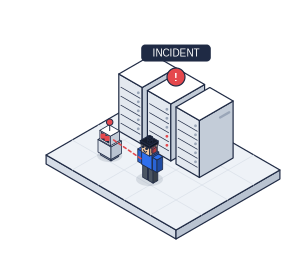
Every SRE team is being asked the same question: “Can an AI agent handle incidents?” The honest answer is: it can handle more of the *boring* parts than you’d think, if you start from your runbooks instead of from the model.
Start with the runbook, not the model
An agent with no runbook is a very confident intern with root access. An agent with a good runbook is a fast, tireless teammate. Before connecting any tools, make sure your top incidents have:
- Clear detection: which alert fires, and what it means.
- Diagnosis steps: the exact queries, dashboards and commands a human would run.
- Safe actions: what’s allowed without approval (restart a pod, scale a deployment) and what isn’t (drop a table, fail over a region).
- Exit criteria: how you know it’s fixed.
If a human can’t follow the runbook, an agent won’t either.
Where agents help today
- Triage and context gathering. Pull the last deploy, recent error spikes, related alerts and the relevant runbook into one summary, in seconds.
- Running read-only diagnostics. Log queries, metrics lookups,
kubectl describe, safe, repetitive, and slow for humans at 3 a.m. - Drafting communication. Status-page updates and incident channel summaries, reviewed by a human before sending.
- Writing the post-incident timeline from chat, alerts and commands.
Guardrails that matter
The agent’s worst-case action is your real blast radius. Design permissions for that, not for the happy path.
- Read-only by default. Give write access per action, not per system.
- Human approval for anything that changes production, with the exact command shown.
- Scoped credentials that expire, separate from any human’s account.
- Full audit log of every tool call, input and output.
- A kill switch the on-call engineer can hit instantly.
Measuring whether it helps
Don’t measure “the agent was used”. Measure what on-call actually feels:
- Time from alert to first useful diagnosis.
- Time to mitigation.
- Number of pages that needed no human action.
- How often the agent’s suggestion was wrong, and whether a human caught it.
How to roll it out
- Shadow mode: the agent suggests, humans act. Compare its suggestions with what actually happened.
- Assist mode: the agent runs read-only diagnostics automatically and posts a summary.
- Act with approval: the agent proposes a fix; a human clicks approve.
- Autonomous for narrow, well-tested runbooks only: and reviewed regularly.
The architecture behind it
The agent needs the same things your system does: observability, clear boundaries and fallbacks. If you’re designing the service it watches, the patterns in serving an LLM API in production apply here too. And the way you package runbooks for agents looks a lot like writing Claude Code skills: one job per instruction file, with exact commands and a sharp description.
FAQ
Will AI agents replace on-call engineers?
Not soon. They reduce toil (gathering context, running diagnostics, writing updates) so humans can focus on judgment calls.
What’s the safest first use case?
Read-only triage summaries posted to the incident channel. High value, no production risk.
How do I stop an agent from making things worse?
Least-privilege credentials, approvals for every write action, and a hard rule that it stops and escalates when a runbook step fails.